How we moved the National library of Latvia to the Castle of Light

Some moves are the kind where the cost of a mistake is a broken chair. Others put a nation’scultural heritage on the line. Relocating the collection of the National Library of Latvia to its newhome — the Castle of Light (Gaismas pils) — was firmly the second kind: a unique, national-scale project where every single item is irreplaceable and where sequence, tracking and carematter just as much as the physical transport.
FF International Movers was the partner entrusted with this task. In this article we share what welearned moving one of the largest and most sensitive collections in Latvia — not to boast, butbecause projects like this show, better than anything, what separates professional large-scalemoving from ordinary box-shifting.
If you are planning an office, archive, library or other large-volume relocation, this experienceshows what actually determines a successful result.
How we moved the airBaltic office without downtime
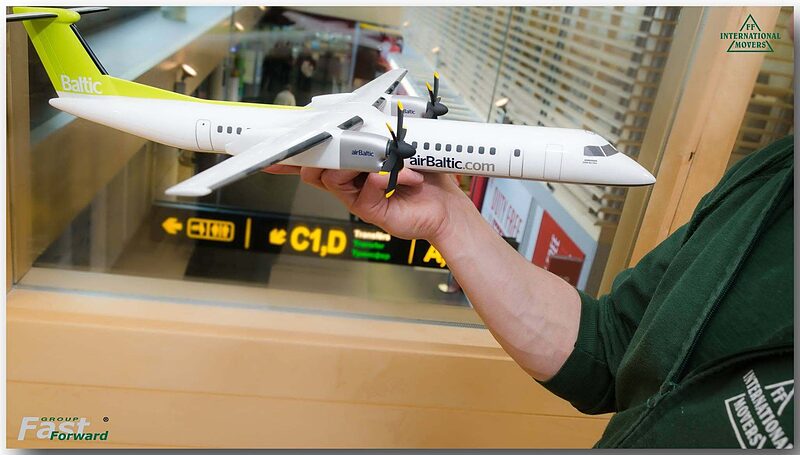
An office relocation for a large company is not about boxes — it is about making sure that the next morning,work continues as if nothing had changed. When the organisation is airBaltic, where operations run around theclock, every hour of downtime has a real cost. That is why relocating the airBaltic head office was a projectwhere the main task was not moving furniture, but making sure the company did not lose a single working day.
FF International Movers was the partner trusted with that job. In this article we share what we learnedcoordinating a large corporate office move — not to boast, but because projects like this show exactly whatseparates professional office moving from ordinary box transport.
If you are facing an office, IT infrastructure or other large-scale relocation, this experience shows what reallydecides the outcome.
Office Relocation in Riga: How to Move Without Losing Productivity
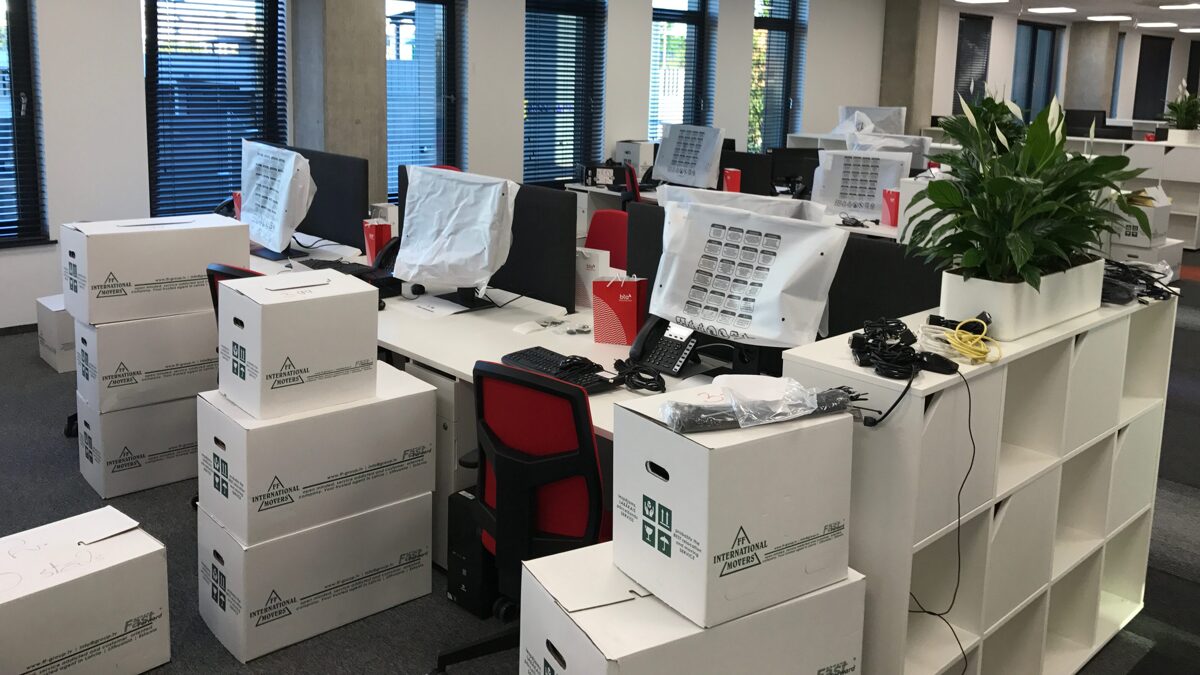 Relocating your office in Riga is a significant undertaking — one that can either disrupt your business for days or be completed with barely a ripple in your daily operations. The difference almost always comes down to planning, timing, and choosing the right professional partners
Whether you’re a local company outgrowing your current space, an international business setting up in Latvia, or expanding your Riga presence, this guide covers everything you need to know to execute a smooth, efficient office relocation. As a moving company operating since 2001 and a FEDEMAC member since 2003, we’ve helped hundreds of businesses make the transition — including the airBaltic head office and the collection of the National Library of Latvia. Here’s what actually works.
Why Office Relocation in Riga Requires a Different Approach
Corporate and office moves aren’t simply “bigger household moves.” The stakes are fundamentally different: employee productivity, client service continuity, IT infrastructure, specialized equipment, and the legal requirements around address changes all need to be managed simultaneously.
Riga presents its own specific logistical considerations. The city centre has numerous historic buildings with narrow staircases, restricted vehicle access zones, and buildings without freight lifts — all of which require experienced movers who know the terrain. Newer business districts like Skanste or Ķīpsala offer more accessible infrastructure, but coordination with building management is still essential.
The good news: with proper planning and a professional office moving company, a Riga office relocation doesn’t have to mean lost productivity. In fact, a well-executed move can actually boost morale — employees arrive at a fresh, organized workspace ready to perform.
Planning Your Office Relocation: A Timeline That Works
The most common mistake companies make is underestimating how far in planning needs to begin. For a small office (under 15 people), six weeks is the minimum. For a mid-size or large business, start the process eight to twelve weeks ahead.
8–12 weeks before moving day:
Begin with a complete audit of what’s moving and what isn’t. This is the perfect opportunity to declutter —office equipment that’s been unused for years doesn’t need to follow you to the new space. Identify what needs special handling: server equipment, large conference tables, specialized machinery, confidential document archives.
Contact both your current and new building management to understand their specific requirements for moves: freight lift bookings, permitted moving hours, parking restrictions for large vehicles, and security access protocols. In Riga’s city centre, parking coordination for moving trucks can require advance permits — your professional mover should handle this, but it needs to be arranged early.
Select your office moving company. Get at least two or three quotes, but don’t choose on price alone — ask about experience with corporate moves, insurance coverage, IT equipment handling, and weekend availability.
4–6 weeks before moving day:
Notify all relevant parties about your address change: clients, suppliers, banks, government authorities (the State Revenue Service and the Enterprise Register in Latvia require updated registration details), and any subscriptions or services tied to your current address. Don’t leave this until moving week.
Communicate clearly with your team. Employees who understand the timeline, the new office layout, andwhat’s expected of them on moving day are far more cooperative — and far less stressed. Share the floor plan of the new office if possible so people can visualize their new workspace.
Plan your IT infrastructure migration in detail. Internet connectivity at the new location should be confirmed and ideally activated at least one week before the move. Server relocation should be scheduled for minimal-traffic periods.
1–2 weeks before moving day:
Label everything. Every box, every piece of furniture, every cable. Clear labelling systems (by department, by room in the new office, by priority of unpacking) save hours on moving day and the days that follow. Assign a responsible person from each department to oversee the labelling of their area’s belongings.
Document the condition of your current office with photographs — both for your own records and for any deposit return discussions with your landlord.
Moving day:
Have your project coordinator present at both locations throughout the day. Professional movers work efficiently when they have a single clear point of contact who can make decisions on the spot.
Minimising Downtime: The Phased Approach
For companies that cannot afford even a single day of full operational downtime, a phased relocation is the answer. Rather than moving everything at once, you migrate in stages — typically over a weekend or across two to three days.
Phase 1 — Remote-capable departments first. Marketing, HR, and administrative teams can typically work from home or the new location even before everything is fully set up. Moving them first reduces the volume for later phases.
Phase 2 — IT infrastructure. Servers and core network equipment should move as a dedicated operation, ideally overnight or on a Saturday, with your IT team on hand for reconnection and testing before the business day begins.
Phase 3 — Client-facing and operations teams last. Customer service, finance, and sales departments — the ones where a disruption immediately impacts revenue — move only once the new office is confirmed operational.
This approach requires more coordination but typically results in near-zero downtime for the business as a whole.
What Professional Office Movers Provide (And Why It Matters)
It’s tempting to handle an office move internally — assigning employees to pack, hiring a general removal company, or renting a van. For small moves of one or two rooms, this can work. For anything larger, it almost always costs more in the long run through lost time, damaged equipment, and stressed staff.
Professional office moving companies provide:
Specialised packing for sensitive equipment. Monitors, servers, printers, and other electronics require anti-static materials and specific packing protocols. A professional team knows how to pack these safely and will document the condition of the equipment before it’s moved.
Furniture disassembly and reassembly. Large conference tables, modular workstations, and ergonomic furniture systems often need to be partially or fully disassembled for transport. Professional movers handle this quickly and reassemble it correctly at the destination.
Insurance and liability coverage. A reputable office moving company carries insurance that protects your assets during transit. If something is damaged, you’re covered. This is simply not the case when colleagues move items informally.
Efficiency that reduces downtime. An experienced team moves an office in a fraction of the time an improvised operation takes. Time directly translates to productivity — and staff goodwill.
Knowledge of Riga’s logistics. Parking permits in restricted zones, freight lift booking protocols, building access requirements — experienced local movers have handled all of these before and navigate them without incident.
IT Infrastructure: The Critical Path
IT is consistently the most complex element of any office relocation. A thoughtful IT migration plan is non-negotiable for businesses that depend on digital systems (which is virtually every business today).
Key principles for IT relocation:
Confirm internet connectivity at the new location well in advance. In Latvia, provisioning business-gradeinternet connections from providers like Tet or LMT typically takes one to three weeks — do not leave this until the last moment.
Never transport server equipment in regular moving boxes. Servers require climate-controlled transport, anti-static packaging, and careful handling. If your company runs physical servers, discuss this with your movers explicitly and consider whether your IT team should be present for the transport.
Create a full backup of all critical data before anything is unplugged. This is basic practice, but in the chaos of a move, it’s easy to skip. Make it a formal checkpoint on your project plan.
Plan for a testing window after IT systems are reconnected. Allow at least four hours between when servers and network equipment are reconnected and when employees are expected to be operational. Unexpected issues are common and need time to be resolved.
Address Change Requirements in Latvia
One administrative element that catches many businesses off guard: in Latvia, changing your registered business address requires updating your registration with the Enterprise Register (Uzņēmumu reģistrs). This is not automatic and must be submitted formally.
Additionally, if your business is VAT-registered, you’ll need to update your details with the State Revenue Service (Valsts ieņēmumu dienests). Banks also require formal notification of address changes for corporate accounts.
International companies operating in Latvia should ensure their local representative or accountant handles these administrative updates promptly — delays can cause complications with official correspondence and compliance.
The Cost of Office Relocation in Riga: What to Expect
Office relocation costs in Riga depend on several variables, and any reputable company will require an on-siteassessment before providing a final quote. Be cautious of any mover that quotes over the phone without seeing the space.
Key cost factors:
Volume and distance. More items and greater distance mean higher cost. Intra-Riga moves are significantly less expensive than moves to other Latvian cities or international relocations.
Timing. Weekend and evening moves typically cost more per hour but reduce your business downtime costs. For many companies, the productivity savings far outweigh the premium.
Additional services. Furniture disassembly and reassembly, specialist packing for IT equipment, document archive handling, storage solutions, and post-move cleaning all add to the total but often represent significant value.
Building access challenges. If your current or new office is on a high floor without a freight lift, or in a restricted-access location, this affects the complexity and duration of the move.
Request quotes from two or three companies, ensuring each quote is based on the same scope of work. The cheapest option is rarely the best option when it comes to protecting your business assets.
Office Relocation Checklist for Riga Businesses
Use this checklist to stay on track:
8–10 weeks out:
- Confirm new office lease and access dates
- Book a freight lift at both buildings
- Request moving quotes from professional companies
- Appoint an internal project coordinator
- Order a new internet connection for the new office
4–6 weeks out:
- Sign a contract with the chosen moving company
- Notify clients, suppliers, and partners of the address change
- Update address with Enterprise Register and State Revenue Service
- Notify your bank
- Communicate the moving plan to all employees
2 weeks out:
- Begin labelling furniture and non-essential items
- Arrange parking/access for moving vehicles
- Plan IT migration sequence
- Confirm the moving day timeline with your mover
Moving week:
- Back up all data
- Pack personal desks and non-essential items
- Photograph the current office condition
- Confirm all arrangements with the moving team
Post-move:
- Test all IT systems before employees arrive
- Update your website, Google Business Profile, and social media with the new address
- Conduct a walkthrough of the old office before handing back the keys
- Collect employee feedback on the first week in the new space
Frequently Asked Questions About Office Relocation in Riga
How long does an office relocation in Riga take? A small office of under 10 people can typically be moved in a single day. A mid-size office of 15–50 people usually requires one to two days. Larger organisations often opt for a phased approach over three to five days to maintain operational continuity.
Do I need to notify Latvian authorities when my company changes address? Yes. Registered businesses in Latvia must update their address with the Enterprise Register (Uzņēmumu reģistrs). VAT-registeredbusinesses also need to notify the State Revenue Service (VID). Your legal representative or accountant can assist with these filings.
Can you move office IT equipment and servers? Yes. FF International Movers has experience with corporate IT equipment relocation, including server racks and specialised hardware. We recommend coordinating directly with your IT team to ensure proper documentation of equipment condition before and after transport.
Do you offer weekend office moves in Riga? Yes. Weekend relocation is often the preferred option for businesses looking to minimise disruption to working hours. Contact us to check availability for your preferred dates — weekends during peak season (spring and autumn) book up quickly.
What insurance coverage do you provide during the move? We offer insurance options for goods in transit during your office relocation. The specific coverage details are discussed and agreed upon during the consultation and contract stage.
Plan Your Riga Office Relocation with FF International Movers
A successful office relocation in Riga doesn’t happen by accident — it’s the result of careful planning, professional execution, and an experienced team that knows how to protect your assets and your business operations throughout the process.
FF International Movers has been handling corporate and office relocations in Latvia since 2001. As a member of FEDEMAC (the Federation of European Moving Associations) since 2003, we operate to the highest European standards in both local and international moves. Our track record includes the relocation of the airBaltic head office and the collection of the National Library of Latvia to the Castle of Light.
Whether you’re moving across Riga or relocating an international office to Latvia, our team provides a complete service — from the initial consultation and on-site assessment to furniture reassembly and post-move support.
Get in touch today for a free consultation and detailed quote:
- Phone: +371 29160077
- Email: info@ffinternationalmovers.lvv
- Website: ffinternationalmovers.lv
- Services: Office Relocation | International Moving | Corporate Moves
The sooner you reach out, the more options we have to fit your timeline. Weekends and peak season dates fill quickly — don’t leave your move to chance.
Cost of Moving to Latvia in 2026: The Complete Price Guide
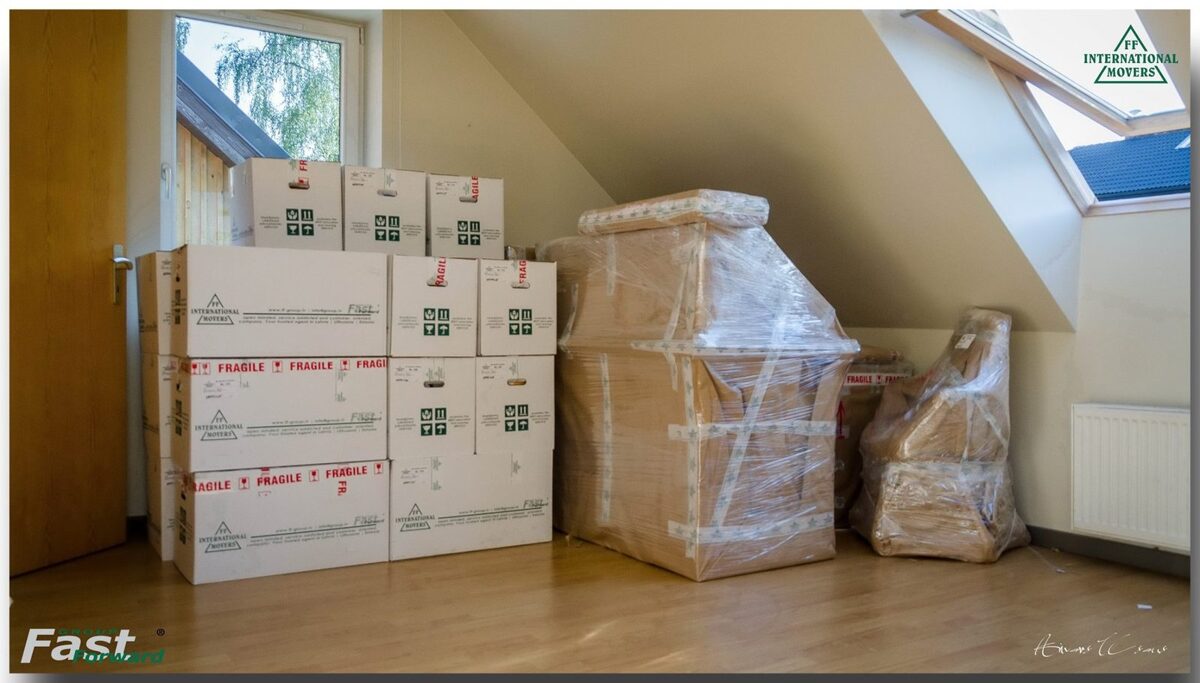
One of the first questions every expat asks before relocating is the simplest one: how much will it cost? The honest answer is that there is no single price. The cost of moving to Latvia can vary by several thousand euros depending on where you are moving from, how much you bring, and how much of the work you hand to professionals.
This guide breaks down the real cost of an international move to Latvia in 2026 — with realistic price ranges by origin country and household size, an explanation of what actually drives the cost, and practical ways to keep your budget under control without cutting corners that matter.
At FF International Movers, we have been arranging international relocations to and from Latvia since 2001, and as a FEDEMAC member since 2003, we work to European industry standards. Over 25 years, we have handled hundreds of moves into Riga from across Europe and beyond, so the numbers below reflect what these moves actually cost in practice — not guesswork.
What Drives the Cost of Moving to Latvia
International moving costs are not random. They are built from a handful of concrete factors, and once you understand them, you can compare quotes properly and avoid hidden surcharges.
Volume. This is the single biggest cost driver. International freight is priced largely by the cubic metres (m³)your belongings occupy. A studio flat might be 10–15 m³; a full family home can exceed 50 m³. The more you ship, the more you pay — which is why deciding what to leave behind is the most effective way to lower your bill.
Distance and origin country. A road move from Germany or Poland reaches Riga in a few days and costs less than a move from the UK, Spain, or overseas. Origin also determines whether customs clearance is required(see below), which adds both cost and time.
Transport mode. Road freight is the standard, cost-effective option for moves within Europe. Sea freight becomes economical for large volumes and long distances but takes weeks. Air freight is the fastest and most expensive, suited only to small, urgent shipments.
Services included. Professional packing, furniture dismantling and reassembly, appliance disconnection, temporary storage, and handling of special items (pianos, safes, artwork) each add to the price — but often save you time, stress, and the cost of damage.
Access and floor. Narrow staircases, no lift, or restricted truck parking at either end add labour time. Riga’s historic centre, with its older buildings and tight stairwells, frequently falls into this category.
Customs (non-EU origins). Moving from outside the EU — the UK, USA, Australia — adds customs clearance, documentation, and potentially duties, typically €300–600 on top of the freight cost.
Cost of Moving to Latvia by Origin — Realistic Ranges
The figures below are illustrative full-service ranges (including professional packing) for a move into Riga. Your exact price depends on volume, access, and season, but these give you the right order of magnitude.
| Origin | One-bedroom (10–20 m³) | Two–three bedroom (25–40 m³) | Full family home(50+ m³) |
|---|---|---|---|
| Germany (road) | €800–1,800 | €1,800–3,200 | €3,500–6,000+ |
| UK (road/ferry +customs) | €1,500–2,800 | €2,800–5,000 | €5,000–8,000+ |
| Nordics / Poland /Baltics | €700–1,600 | €1,600–3,000 | €3,200–5,500+ |
| Spain / Italy / Western EU | €1,400–2,600 | €2,600–4,800 | €4,800–7,500+ |
| Non-EU (USA, Australia, sea) | from €2,500 | from €4,500 | individual quote |
For non-EU origins, add roughly €300–600 for customs clearance and documentation. These ranges typicallycover labour, transport, basic equipment, and professional packing — but always confirm exactly what each quote includes before comparing.
What’s Usually Included — and What Isn’t
A transparent full-service quote should make clear which of the following are included and which are charged separately:
- Usually included: loading and unloading labour, transport to your Latvian address, basic protective equipment (blankets, straps, trolleys), and a dedicated move coordinator.
- Sometimes extra: professional packing materials, full packing labour, furniture dismantling/reassembly, appliance disconnection, delivery to a specific floor, and VAT.
- Add-ons: temporary storage in Riga, special-item handling (piano, safe, fine art), and additional transit insurance above the standard cover.
The cheapest headline price is rarely the cheapest outcome. A low quote that excludes packing, customs, or destination services is not actually cheaper — it is just less transparent. Always ask for an itemised written quote.
Hidden Costs to Watch For
Behind an attractive starting figure, less reputable operators sometimes add charges that only appear on the final invoice:
- Floor or stair surcharges that were never mentioned in the quote.
- Waiting-time fees when there is no parking or lift at the destination.
- Packing materials excluded from the “base” price.
- Minimum-load or out-of-area fees.
- Vague insurance terms that leave you uncompensated if something is damaged.
A professional mover lists all of these in the quote itself. A detailed, written estimate is exactly what separates a genuine company from a casual carrier.
How to Reduce the Cost of Your Move to Latvia
You can lower your moving costs without sacrificing quality. A few practical tips:
- Cut volume first. Sell, donate, or discard what you no longer use before the survey. Shipping bulky, low-value furniture across Europe often costs more than buying new on arrival in Riga.
- Move off-peak. Mid-month and weekday moves outside the June–September peak are easier to book and often cheaper.
- Self-pack the simple things. Pack books and clothing yourself and leave fragile items and furniture to professionals to reduce packing labour.
- Consider groupage. For one- or two-room moves, sharing container or truck space with other shipments going the same way is significantly cheaper than a dedicated load.
- Book early. Early reservation gives better availability and avoids rush surcharges.
Frequently Asked Questions
How much does it cost to move to Latvia from the UK? For a full-service move including packing and customs clearance, expect roughly €1,500–2,800 for a one-bedroom and €2,800–5,000 for a two-to-three-bedroom household. The exact figure depends on volume and access — a survey gives you a fixed price.
How much does it cost to move to Latvia from Germany? Germany–Latvia is a well-established road corridor. A studio or one-bedroom move typically runs €800–1,800, a two-bedroom flat €1,800–3,200, and a full home €3,500 and up.
Why can’t a mover give me a firm price over the phone? A reliable mover can give you a ballpark, but an accurate fixed price requires assessing your actual volume and access — in person or by video survey. A price quoted without seeing your belongings usually changes later.
Do I have to pay customs duties when moving to Latvia? Not for moves within the EU, where personal goods move freely. From outside the EU, personal effects you have owned for at least six months can usually be imported duty-free under the transfer-of-residence relief, but documentation and a clearance fee apply.
Is it cheaper to ship my furniture or buy new in Latvia? It depends on the item. Large, heavy, or low-valuefurniture is often more expensive to ship across Europe than to replace on arrival. Assess each piece’s value against its transport cost before deciding.
Get an Accurate Quote for Your Move to Latvia
Want to know exactly what your move to Latvia will cost? The only reliable way is a free survey. After assessing your real volume and access, FF International Movers provides a fixed, transparent quote with no hidden surcharges.
Operating since 2001 and a FEDEMAC member since 2003, we handle the full logistics chain — packing, transport, customs documentation, and delivery to your new home in Latvia.
- Email: info@ffinternationalmovers.lv
- Phone: +371 29160077
- For expats: http://movingtoLatvia.lv
The earlier you start planning, the smoother — and often cheaper — your move will be. Get in touch for a no-obligation quote and start your Latvian chapter on solid footing.
Moving from UK to Latvia: The Complete Guide
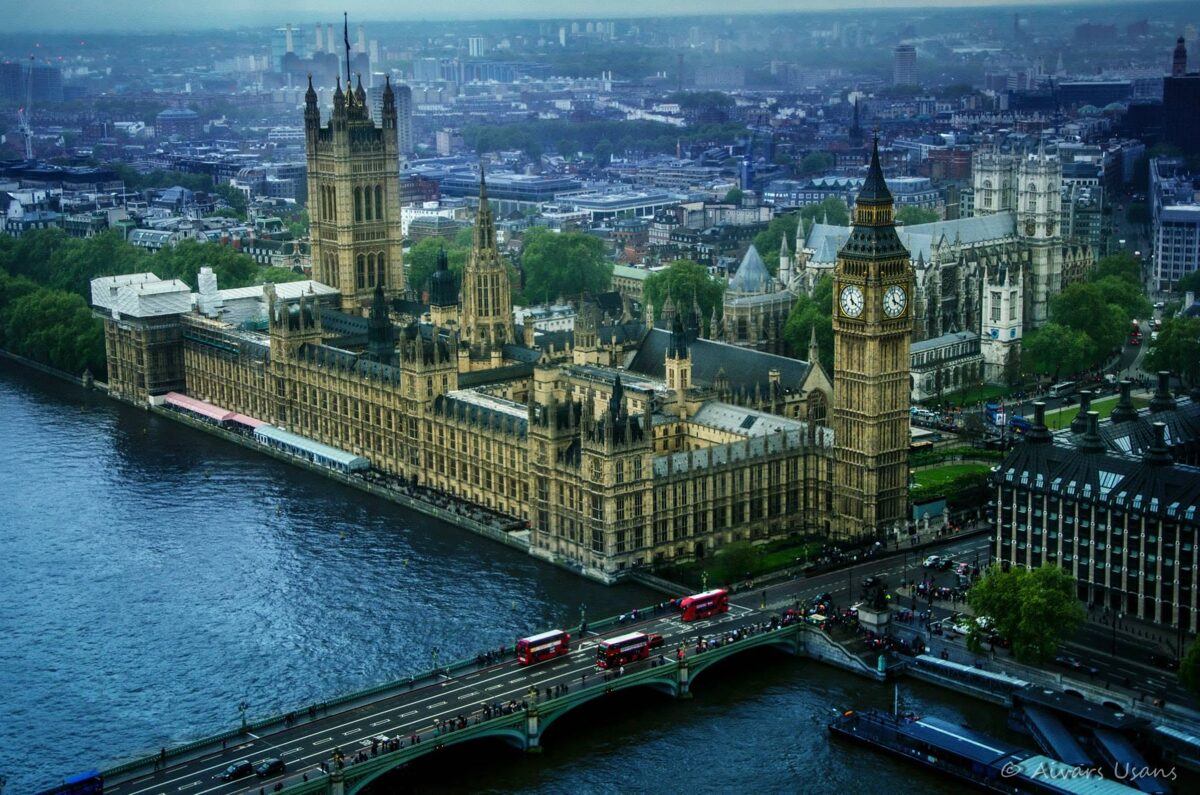
Relocating from the United Kingdom to Latvia is one of the most popular moves we help facilitate at FFInternational Movers. Whether you’re drawn by Latvia’s growing tech scene, lower cost of living, historic Riga, or a family connection, this guide covers everything you need to know — from post-Brexit visa requirements to getting your belongings safely across the Baltic Sea.
We’ve helped hundreds of British nationals make this move. Here is exactly what to expect.
Post-Brexit: What UK Citizens Need to Know Before Moving to Latvia
Since the UK left the EU, British nationals are no longer EU citizens and cannot simply move to Latvia without going through a formal immigration process. This is the single most important thing to understand when planning your relocation.
Short stays (up to 90 days): UK citizens can visit Latvia visa-free for up to 90 days within any 180 days. This is fine for house-hunting trips or exploratory visits, but you cannot work or establish residency during this time.
Long-term residence (more than 90 days): You will need to apply for a Latvian residence permit. The most common routes for British nationals are:
- Employment-based: Your Latvian employer sponsors your work permit and residence permit. This is the most straightforward route if you have a job lined up.
- Self-employment/business: You can register a company or self-employment status in Latvia and apply on that basis.
- Joining family: If your spouse or close family member is an EU/EEA citizen residing in Latvia, you can apply for a residence permit as a family member.
- Financially independent: Latvia allows residence permits for individuals who can demonstrate sufficient financial means (the threshold changes periodically — check with the Office of Citizenship and Migration Affairs, OCMA).
The OCMA (Pilsonības un migrācijas lietu pārvalde) is the Latvian government authority that handles allresidence permit applications. Their website (pmlp.gov.lv) has current fee schedules and processing times. Initial temporary residence permits are typically issued for one to five years, with the option to extend or apply for permanent residence after five years.
Pro tip: Start your residence permit process before you move, or at a minimum within the first 30 days of arrival. Working with a local immigration lawyer or relocation specialist can save significant time and stress.
Shipping Your Belongings from the UK to Latvia: What to Know
Once your legal status is sorted, the practical question is how to get your household goods from the UK to Latvia. The distance from London to Riga is approximately 1,900 km, and there are several shipping options depending on how much you’re moving.
Full Container Load (FCL): Best for large family moves or full household contents. A standard 20-footcontainer holds roughly the contents of a two-bedroom flat. Transit times are typically 7–14 days, though seafreight routing can vary.
Groupage / LCL (Less than a Container Load): Your belongings share a container with other shipments. More economical for partial moves or studio/one-bedroom volumes. Slightly longer transit times (2–4 weeks) due to consolidation.
Road freight (road truck): For many UK-to-Latvia moves, a dedicated road truck is actually the most efficient and cost-effective option, especially for medium-to-large volumes. FF International Movers operates direct routes from the UK to Riga, with typical transit times of 2–4 days once the truck departs.
What determines the cost: Volume of goods (measured in cubic metres), distance, services included(packing, unpacking, insurance), and current fuel/ferry tariffs. A rough estimate for a one-bedroom move from London is €1,200–€2,500; a full family home can range from €3,500–€7,000+. Request a detailed quote early— prices vary significantly between providers.
Customs and Taxes When Moving Personal Belongings to Latvia
Latvia is an EU member state, which means UK goods entering Latvia are subject to EU customs regulationspost-Brexit. However, there is a valuable exemption for household goods: the Transfer of Residence (ToR)relief.
Under ToR relief, you can import your personal belongings and household goods duty-free and VAT-free when you are moving your habitual residence to an EU country. To qualify:
- You must have been a resident outside the EU for at least 12 consecutive months.
- The goods must have been owned and used by you for at least 6 months before the move.
- You must import the goods within 12 months of establishing your new Latvian residence.
- Goods imported under ToR relief cannot be lent, pledged, or sold for at least 12 months after importation.
Documents you will need: Proof of previous residence in the UK (utility bills, lease, bank statements), proof of new residence in Latvia (rental contract, registration with OCMA), a detailed inventory of goods being shipped, and in some cases, proof of ownership for high-value items.
Motor vehicles are a separate matter — importing a UK-registered car to Latvia involves paying VAT and potentially customs duty, plus re-registering the vehicle in Latvia. Many people find it more economical to sell their UK car and buy in Latvia.
A professional international mover like FF International Movers will prepare the customs documentation on your behalf and guide you through the ToR application process — this is one area where experience genuinely matters.
Setting Up Life in Latvia: Practical Steps After Arrival
Registration: Once you have your residence permit, you must register your address with the local parish or city council (pagasts or pilsētas pašvaldība). This is your official address for all Latvian government correspondence.
Personal ID code (personas kods): Latvia assigns a personal identification code to all residents. You will receive this when your residence permit is issued. It is used for everything from banking to healthcare to signing contracts.
Banking: Most major Latvian banks (Swedbank, SEB, Luminor) will open accounts for EU residents with a valid residence permit and personas kods. The process typically takes 1–2 weeks. Online banking in English is available at all major banks.
Healthcare: Latvia has a state health insurance system, but coverage requires you to be employed or pay social insurance contributions. Many expats in Latvia maintain private health insurance, especially in the first year. BUPA and AXA both operate in Latvia.
Driving licence: UK driving licences issued before Brexit can be exchanged for a Latvian licence without a test, provided you register within the required timeframe. Check current CSDD (Road Traffic Safety Directorate) requirements as these rules have been evolving.
Language: Latvian is the official language. Russian is widely spoken in Riga and eastern Latvia. English proficiency is high among younger generations and in business environments. Most expats get by comfortably in English in Riga; outside the capital, some basic Latvian or Russian is helpful.
Cost of Living Comparison: UK vs Latvia
One of the primary reasons British nationals relocate to Latvia is the significantly lower cost of living. Here are approximate comparisons (Riga vs London):
- Rent: A 2-bedroom flat in central Riga costs €700–€1,200/month vs £2,000–£3,500 in central London.
- Groceries: Roughly 30–40% lower than UK equivalents.
- Eating out: A meal for two at a mid-range Riga restaurant: €30–€50. London equivalent: £70–£120.
- Utilities (heating, electricity, water): Riga flat average €150–€250/month. Note: Latvian winters are cold— heating costs are real.
- Public transport: Monthly Riga public transport pass: €50. Excellent tram, bus, and trolleybus network.
Outside Riga, costs drop further. Cities like Jūrmala, Jēkabpils, or Valmiera offer a high quality of life at considerably lower cost.
Frequently Asked Questions
Do I need a visa to move from the UK to Latvia? UK citizens do not need a visa for stays up to 90 days. For longer stays or to work and live in Latvia, you need a residence permit issued by the OCMA. The specific type depends on your situation (employment, family, self-sufficiency).
How long does it take to ship belongings from the UK to Latvia? By dedicated road truck: 2–4 days. By groupage freight: estimated 2 weeks, depending on consolidation schedules. Sea freight: 7–14 days pluscollection/delivery time.
Can I bring my pet from the UK to Latvia? Yes. Latvia follows EU pet travel rules. Your pet needs a microchip, a valid EU-format pet passport (or third-country health certificate), and an up-to-date rabies vaccination. There is no quarantine requirement if documentation is in order.
Is Latvia a good country for British expats? Many British expats find Latvia an excellent base — affordable, safe, with good infrastructure and a vibrant expat community, especially in Riga. The tech and startup scene has attracted a growing number of UK professionals. English is widely spoken in professional circles.
What is the best city to live in Latvia? Riga is the capital and by far the largest city, with the most job opportunities, international schools, and expat community—Jūrmala (a coastal resort town 25 km from Riga) is popular for families. Smaller cities offer more authentic Latvian life at a lower cost.
Start Your Move from the UK to Latvia with FF International Movers
FF International Movers has been helping people relocate internationally since 2001 — that is, over 25 years of experience navigating exactly the complexities described in this guide. We are a FEDEMAC member (the European Federation of Furniture Removers and Warehousemen), which means we operate to verified European standards of quality and professionalism.
Our UK-to-Latvia service includes door-to-door shipping, professional packing, customs documentation preparation, and dedicated move coordination from your first call to the last box unpacked.
Ready to get started? Contact us for a free, no-obligation quote:
- Website: ffinternationalmovers.lv | movingtolatvia.lv
- Email: info@ffinternationalmovers.lv
We speak English and Latvian, and we are here to make your move from the UK to Latvia as straightforward as possible.
Moving to Latvia: The Complete Expat Guide
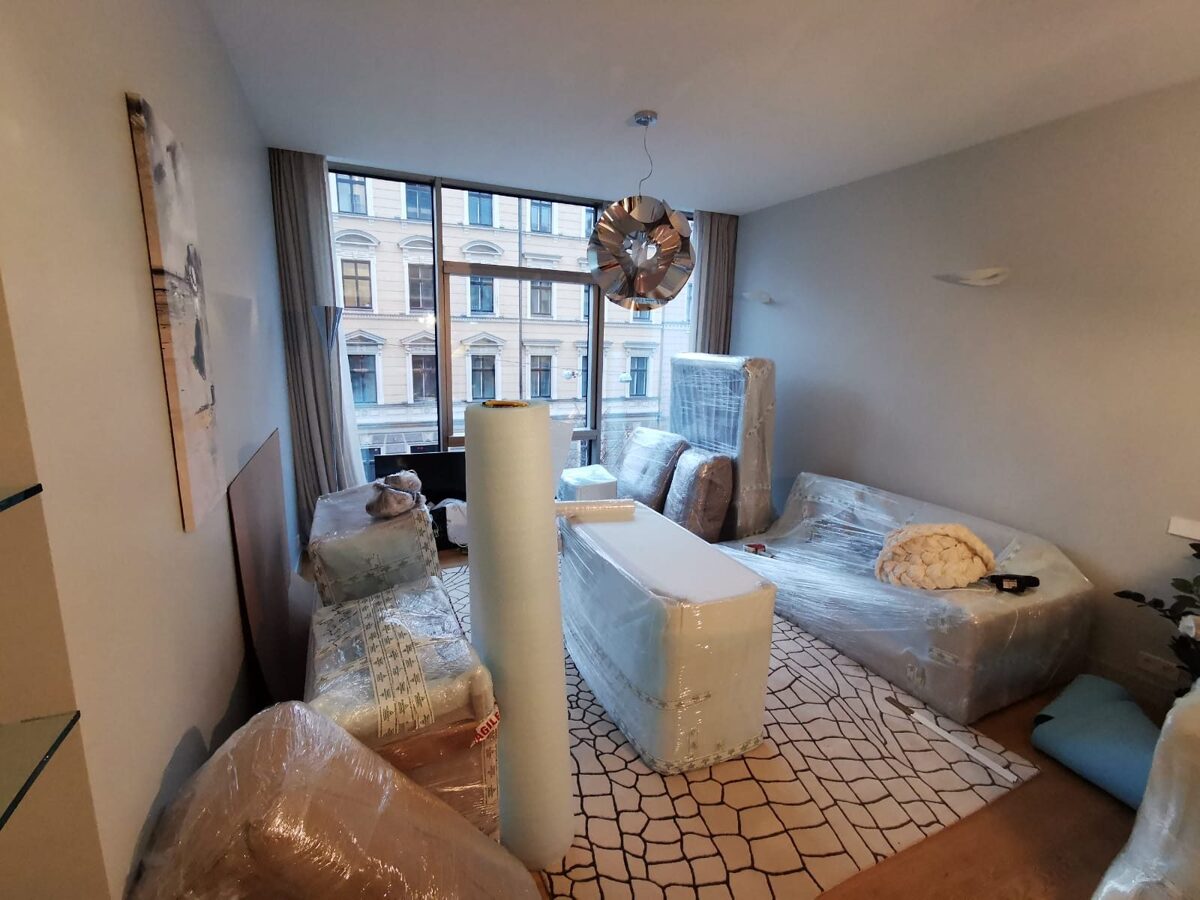
Thinking about moving to Latvia? You’re not alone. Over the past decade, Latvia — and especially its capital, Riga — has attracted a growing community of expats drawn by its affordable cost of living, vibrant culture, EU membership, and surprisingly short commutes. Whether you’re relocating for work, retirement, or simply a change of scenery, this guide covers everything you need to know before making your move.
At FF International Movers, we’ve been helping people relocate internationally for over 25 years. We’ve supported hundreds of families and professionals arriving in Latvia from across Europe and beyond — andwe’ve seen first-hand what questions come up time and again. This guide answers them.
Why Expats Choose Latvia
Latvia is a small country, but it punches above its weight for quality of life. Here’s what consistently draws people in:
Cost of living. Riga is significantly more affordable than most Western European capitals. A comfortable apartment in the city centre can be rented for €600–900/month. Groceries, dining out, and local transport are all considerably cheaper than in the UK, Germany, or the Netherlands.
EU membership and the Euro. Latvia joined the EU in 2004 and adopted the Euro in 2014. For EU citizens, this makes bureaucracy straightforward. For non-EU nationals, EU residency in Latvia is a gateway to broader European mobility.
Digital infrastructure. Latvia consistently ranks among the top countries in Europe for digital government services. You can register a company, file taxes, and access healthcare records entirely online. The country has also produced a disproportionate number of tech unicorns per capita.
Riga’s character. The capital is compact, walkable, and genuinely beautiful. The UNESCO-listed Art Nouveau district is one of the largest in the world. Summers are long and social; winters are cold but come with excellent cross-country skiing and proper Christmas markets.
Visa and Residency Requirements for Moving to Latvia
Your route into Latvia depends on your citizenship.
EU/EEA citizens have the right to live and work in Latvia without a visa. You should register your residence with the Office of Citizenship and Migration Affairs (PMLP) within three months of arrival. Registration is straightforward and done in person or online.
Non-EU nationals will generally need to apply for a residence permit. Common routes include:
- Employment-based permit — requires a job offer from a Latvian employer. Your employer typically initiates the process.
- Business/investor permit — for entrepreneurs setting up a company or making qualifying investments.
- Family reunification — if your spouse or partner is an EU citizen or Latvian resident.
- EU Blue Card — for highly skilled non-EU workers. Latvia has relatively accessible salary thresholds compared to Germany or France.
- Digital nomad visa — Latvia introduced provisions for remote workers; consult the PMLP website for current eligibility.
Processing times vary. For long-stay permits, allow 1–3 months and apply well before your intended arrival. The PMLP (pmlp.gov.lv) publishes current requirements in English.
Finding Housing in Latvia
Most expats start in Riga, which offers the widest range of housing and the strongest expat community. A few things to know:
Renting. The rental market is active but can move quickly in popular neighbourhoods. Riga’s most sought-after areas for expats include the Quiet Centre (Klusais centrs), Mežaparks (a forested neighbourhood popular with families), and the UNESCO Old Town (Vecrīga) for those who want to be in the heart of the city. Budget€500–800/month for a one-bedroom in a nice area; €800–1,400 for a two-bedroom.
Buying. Latvia allows foreigners to buy property in urban areas. Rural land purchases have some restrictions for non-EU nationals — legal advice is recommended. Prices per square metre in central Riga range from€1,500 to €3,500 depending on the building and finish.
Practical tip. Most landlords and estate agents speak English in Riga. Outside the capital, English is less universal — having a Latvian-speaking contact helps. Portals like ss.lv (in Latvian) and city24.lv (bilingual) is the main rental/sale platform.
Healthcare and Education
Healthcare. Latvia has a public healthcare system, but waiting times at public facilities can be long for non-emergency care. Most expats and many locals use private clinics, which are well-equipped and affordable by Western standards. A GP appointment at a private clinic costs €30–60. EU citizens can use their EHIC for emergency coverage. Non-EU nationals should arrange private health insurance before arrival.
Education. Riga has several international schools offering curricula in English, including the Riga International School and the International School of Latvia (ISL) in Jūrmala. These are popular with expat families and offer IB programmes. Costs range from €8,000 to €15,000 per year.
What to Do With Your Belongings: International Moving to Latvia
This is where most expats feel the biggest practical stress — and where experience makes the biggest difference.
If you’re moving from within the EU, your household goods can move freely without customs duties. If you’rearriving from outside the EU (UK, USA, Australia, etc.), you’ll need to navigate customs clearance. Key points:
- Duty relief for personal effects. You can typically import your personal belongings duty-free if you’veowned them for at least 6 months and are establishing permanent residence. Documentation requirements vary — we can guide you through what’s needed.
- Restricted and prohibited items. Latvia follows EU customs rules. Certain goods (plants, foods, weapons, some electronics) face restrictions. Your moving company should advise on this as part of the packing process.
- Timeline. Depending on origin, sea freight to Riga typically takes 2–4 weeks from Western Europe; longer from further afield. Road freight from most EU countries can arrive in under a week.
FF International Movers has been arranging international shipments to and from Latvia since 2001. We handle the entire logistics chain — packing, transport, customs documentation, and delivery to your new home. As a FEDEMAC member since 2003, we adhere to European standards for professional moving.
Setting Up Life in Latvia: Practical Steps
Once you’ve arrived, here’s what to prioritise in the first few weeks:
- Register your address at the PMLP. This underpins almost everything else — banking, healthcare registration, children’s school enrolment.
- Open a bank account. Major banks include Swedbank, SEB, and Luminor. For non-residents or new arrivals, Revolut and other e-money accounts can bridge the gap while your residency is being confirmed.
- Get a personal identity code (personas kods). Issued by the PMLP once you register for residence.Required for most official processes.
- Register with a GP (ģimenes ārsts). Public healthcare requires registration with a family doctor. Private clinics can be used without registration.
- Sort out transport. Riga has solid public transport (tram, bus, trolleybus), and the centre is walkable. A car is useful if you plan to spend time outside the capital.
Cost of Living Overview
To give you a realistic picture:
| Expense | Approximate Monthly Cost |
|---|---|
| 2-bedroom apartment (Riga centre) | €800–1,200 |
| Groceries for 2 people | €300–450 |
| Dining out (mid-range restaurant, 2 people) | €25–45 per meal |
| Public transport pass | €50 |
| Private health insurance | €80–200 depending on coverage |
| International school (per month) | €700–1,300 |
A comfortable lifestyle in Riga for a family of three typically costs €3,000–4,500/month, well below equivalent cities in Western Europe.
Frequently Asked Questions
Is English widely spoken in Latvia? In Riga and in professional settings, English is widely spoken, especially among people under 40. Outside the capital, Russian or Latvian knowledge is useful. The expat community is active enough that you can manage comfortably in English day-to-day in the city.
How long does it take to get a residence permit? For EU citizens, registration is immediate upon applying.Non-EU temporary residence permits typically take 1–3 months to process. Permanent residency requires 5years of continuous legal stay.
Can I bring my pet to Latvia? Yes. Latvia follows EU pet travel rules. Dogs, cats, and ferrets need an EU pet passport, a microchip, and an up-to-date rabies vaccination. From non-EU countries, additional documentation and potential quarantine periods may apply — check the Food and Veterinary Service (PVD) requirements.
What’s the best time of year to move to Latvia? Late spring (May–June) and early autumn (August–September) offer the best combination of mild weather and available rental housing. Avoid moving mid-winterif possible — road conditions can complicate delivery logistics, and settling into a new home during dark January days is harder than it sounds.
Do I need to learn Latvian? Not to get by, but it is appreciated and will open doors. Latvian is one of the oldest living languages in Europe with relatively few speakers worldwide, so any effort is warmly received. Language courses are widely available in Riga, including evening and weekend options.
Start Your Move to Latvia with FF International Movers
Moving internationally is complex, but it doesn’t have to be stressful. FF International Movers has been organising international relocations since 2001 — including hundreds of shipments to and from Latvia. We handle packing, transport, customs, and delivery, so you can focus on everything else that comes with a major life change.
Whether you’re moving from the UK, Germany, the Netherlands, or anywhere else in Europe, our team can put together a personalised moving plan and guide you through the process step by step.
Visit movingtolatvia.lv for more resources for expats relocating to Latvia, or contact FF International Movers directly to discuss your move:
📞 Contact us for a free moving quote 🌐 ffinternationalmovers.lv 📧 Reach out via our website contact form
We’re here to make your move to Latvia as smooth as possible.
International Movers in Riga: What to Expect
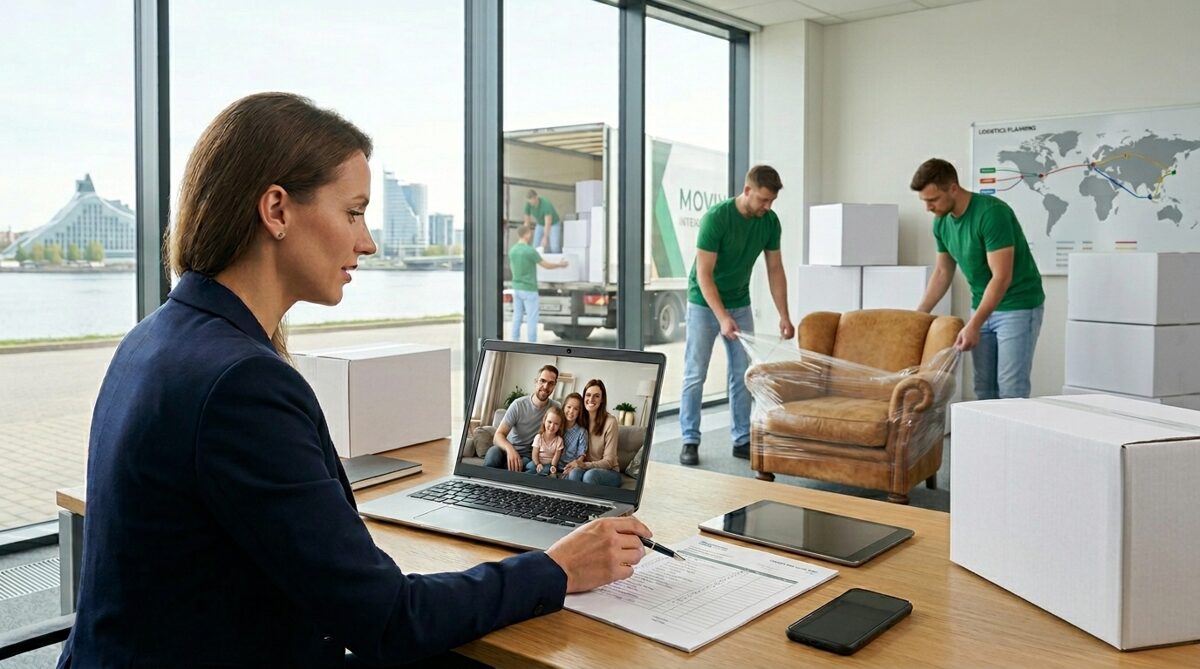
If you’re planning an international move to or from Riga, you’re probably wondering what the process actually looks like — and how to find a moving company you can trust. The international removals industry spans awide range of quality, from well-established operators with decades of experience to fly-by-night outfits that disappear when things go wrong.
This guide walks you through what to expect from a professional international mover in Riga, what the move process looks like from first contact to final delivery, and what separates a good experience from a stressful one.
What International Movers in Riga Actually Do
A professional international moving company does far more than load boxes into a truck. When you hire a full-service international mover, the process typically covers:
Pre-move survey. A reputable company will assess your volume — either in person or via a detailed video call— before giving you a quote. This prevents nasty surprises on moving day when the truck is too small or the price suddenly changes.
Packing. Most international moves include professional packing services. This isn’t optional luxury — it’s a practical necessity. Goods travelling across borders need to be packed to withstand loading, transit, and customs inspection. Proper packing also protects your claim if something is damaged.
Export documentation. When goods cross a border, paperwork matters. An experienced mover will prepare the inventory lists, customs declarations, and certificates of residence needed for your shipment. For non-EUmoves (e.g., from the UK or USA), this is particularly important.
Transport. The actual movement of goods — by road, sea, or a combination — is coordinated by the mover. Riga has excellent logistics infrastructure as a major Baltic port city. Road freight from most EU origins reaches Riga within 1–5 days; sea freight from further afield takes 2–6 weeks.
Customs clearance. For shipments arriving from outside the EU, customs clearance is handled on your behalf. A good mover knows the Latvian State Revenue Service (VID) procedures and what’s needed to clear your personal effects without delays or unexpected duties.
Delivery and unpacking. The final step — delivery to your new address, including carrying items to the correct floor, reassembling furniture if requested, and removing packing materials.
How to Choose the Right International Mover in Riga
Not all removal companies are equal. Here’s what to look for:
Industry membership. The most reliable indicator of professionalism is membership in recognised trade bodies. FEDEMAC (the Federation of European Movers Associations) sets standards for its members across Europe and provides a framework for dispute resolution. FF International Movers has been a FEDEMAC member since 2003 — one of the earliest Latvian companies to join.
Years of experience. International moving is genuinely complex. Companies that have been operating for many years have seen the edge cases — unusual customs situations, delayed ports, moves that happen in three stages over two countries. That experience is worth something. FF International Movers was founded in2001 and has been arranging international relocations for over 25 years.
Transparent quoting. Get at least two or three quotes and compare what’s included. A low quote that excludes packing, customs, or destination services is not really cheaper — it’s just less transparent. Asks specifically whether the quote includes: packing materials, packing labour, customs documentation, delivery to floor, and VAT.
References and reviews. Ask for references from previous international moves, particularly from the same origin country as yours. Online reviews on Google are a useful signal — look for patterns in what people praise and what they complain about.
Insurance. Your goods should be covered during transit. Check whether the mover’s insurance covers full replacement value or depreciated value, and whether it covers international transit including customs.
What the Move Process Looks Like Step by Step
Here’s a realistic timeline for an international move to Riga:
6–8 weeks before your move:
- Contact moving companies and arrange surveys
- Compare quotes and confirm your chosen mover
- Begin gathering documents needed for customs (proof of residence, inventory list, purchase receipts forhigh-value items)
4–6 weeks before:
- Confirm moving dates
- Begin packing non-essential items if self-packing, or plan the packing day with your mover
- Notify utility companies, banks, and relevant government bodies of your move
1–2 weeks before:
- Professional packing takes place (typically 1–2 days for a full household)
- Loading and dispatch
During transit:
- For EU moves: 2–7 days road freight
- For non-EU moves: customs clearance in Latvia (allow 3–7 business days if documentation is in order)
Delivery day:
- Your goods arrive at your new Riga address
- Items are carried to the correct room, and furniture is reassembled if included in your service
- You sign the delivery receipt and report any visible damage at this point
Customs: What You Need to Know
For EU citizens moving within the EU, there are no customs formalities — your goods move freely. For arrivals from the UK, USA, Canada, Australia, or other non-EU countries, customs clearance is required.
The good news: personal household effects can generally be imported duty-free under the “transfer of normal residence” exemption. The conditions are:
- You must have owned the items for at least 6 months
- You must be establishing your primary residence in Latvia (EU)
- You must submit an application to the Latvian customs authority (VID) with supporting documents
Required documents typically include:
- Passport copy
- Proof of previous residence abroad (e.g., utility bills, rental contract)
- Proof of new residence in Latvia (e.g., signed rental contract, registration with PMLP)
- Detailed inventory list with estimated values
Your moving company should guide you through this. If they can’t explain the customs process clearly, that’s a red flag.
What Does an International Move to Riga Cost?
Costs vary significantly based on volume, origin, and service level. As rough benchmarks:
- One-bedroom apartment, EU origin (e.g., Germany or UK): €1,500–2,800 for a full-service move, including packing
- Two-to-three bedroom household, EU origin: €2,500–5,000+
- Non-EU origin (additional customs clearance): add €300–600
These ranges are illustrative. The only way to get an accurate price is to have your volume assessed and receive a detailed written quote. Beware of any mover who gives you a firm price without surveying your goods.
Frequently Asked Questions
How long in advance should I book an international mover in Riga? For standard moves, 4–6 weeks is comfortable. During peak periods (June–September, when most families move), 8 weeks is safer. Last-minutemoves can sometimes be accommodated, but your choice of dates will be limited.
What happens if something is damaged during the move? Report visible damage on the delivery receipt before signing. Photograph everything. Then file a claim with the moving company according to their claim procedure. This is why choosing a company with proper insurance and a clear claims process matters —cheaper operators often make this very difficult.
Can FF International Movers handle a partial shipment if I don’t have a full container’s worth of belongings? Yes. Groupage (shared container) services allow smaller volumes to travel at a fraction of the cost of a full container. Your goods share space with other customers’ shipments travelling to the same destination. It’s slower but cost-effective for one- or two-room moves.
Do I need to be present in Riga for customs clearance? Not necessarily, but you’ll need to sign customs declarations and provide the required documents. Your mover can often handle customs on your behalf with a power of attorney. Discuss this in advance.
What if my new home in Riga isn’t ready yet? Short-term storage is a standard part of the service. Your goods can be held in secure storage in Riga until your apartment is ready. FF International Movers offers flexible storage solutions as part of the relocation package.
Ready to Move? Talk to FF International Movers
FF International Movers is one of Latvia’s longest-established international moving companies, with over 25 years of experience and FEDEMAC membership since 2003. We specialise in international relocations to and from Latvia — helping expats, returning locals, and corporate clients navigate the full process from packing to customs to delivery.
We work with individuals, families, and businesses. Every move gets a dedicated point of contact who knowsLatvia’s logistics landscape and speaks your language — literally.
Contact us to arrange a no-obligation survey and quote:
📞 Call us to discuss your move 🌐 ffinternationalmovers.lv 📧 Contact form on our website
The sooner you start planning, the smoother your move will be. We’re ready when you are.
Moving from Germany to Latvia: Step-by-Step Guide
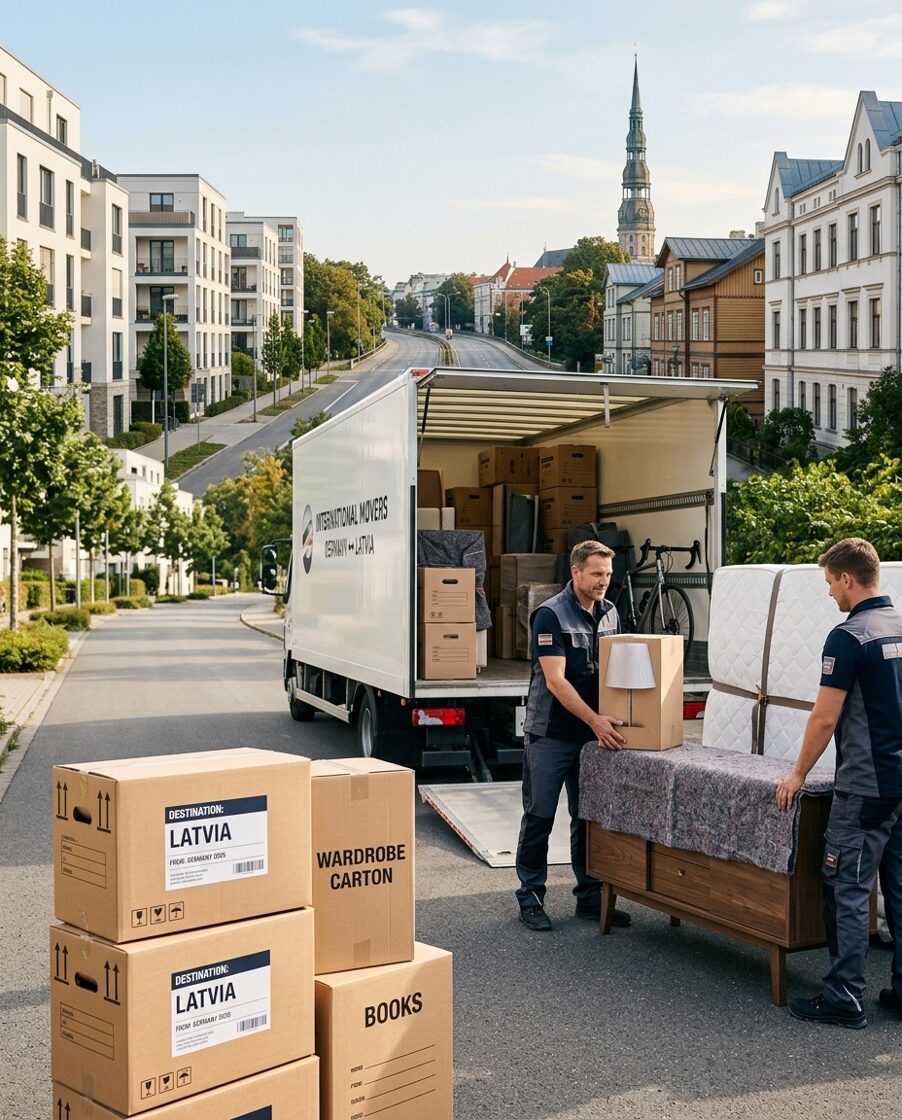
Germany and Latvia share deep historical, cultural, and economic ties, and today there is a steady flow of people relocating between these two Baltic Sea neighbours. Whether you are a German national moving for work, a Latvian returning home after years in Deutschland, or someone simply seeking a different pace of life, this step-by-step guide covers everything you need to plan a smooth move.
At FF International Movers, we regularly handle relocations on this exact route — it is one of our most common corridors. Here is what we have learned from hundreds of Germany-to-Latvia moves.
Step 1: Understand Your Rights as an EU Citizen Moving to Latvia
This is the good news if you are a German national: as a citizen of an EU member state, you have the right to live, work, and reside in Latvia without a visa or work permit. Freedom of movement is one of the fundamental rights of EU citizenship.
What you are required to do upon arrival:
- Register your address with the local municipality (pagasts or pilsētas pašvaldība) within 90 days of arrival. This is your official Latvian address for all government purposes.
- Register with the OCMA (Office of Citizenship and Migration Affairs — Pilsonības un migrācijas lietupārvalde) if you intend to stay longer than three months. EU citizens receive a registration certificate rather than a residence permit — this is a formality, but an important one.
- Obtain a Latvian personal identification code (personas kods) — this is assigned when you register and is required for banking, healthcare, employment contracts, and most official transactions.
The entire registration process is straightforward and can usually be completed within one to two weeks of arriving in Latvia. The OCMA offices are located in Riga and regional centres across Latvia.
If you are a Latvian citizen returning from Germany, the process is even simpler — you are registering as a returning citizen, not an immigrant. Contact the OCMA or your home municipality to re-register your residence.
Step 2: Plan the Logistics — Shipping Your Belongings from Germany to Latvia
Germany to Latvia is a well-established road freight corridor. Riga is approximately 1,400 km from Berlin and around 1,600 km from Munich, making direct truck transport the most efficient option for most moves.
Typical transit times by road: 2–3 days from northern Germany (Hamburg, Berlin); 3–4 days from southern Germany (Munich, Stuttgart, Frankfurt).
Your shipping options:
Dedicated truck (Full Load): Your belongings fill an entire truck, which drives directly to your Latvian address.Best for large family moves or full flat/house contents. Fast, predictable, and your goods are handled only once. Recommended for moves of 25+ cubic metres.
Groupage (Shared Load / LCL): Your boxes and furniture share truck space with other customers’ shipments going in the same direction. More economical for smaller volumes (studio, one-bedroom flat). Transit can be 1–2 weeks, depending on consolidation schedules.
Parcel freight: For small volumes (a few boxes, personal items), courier services like DPD, DHL or UPS can be cost-effective. However, for anything with furniture, dedicated moving freight is almost always a better value.
What drives the cost:
Volume (cubic metres) is the primary cost driver. Additional factors include floor access at origin and destination, packing services, insurance, and current fuel surcharges. Rough estimates for Germany-to-Latvia road freight:
- Studio/one bedroom (10–20 m³): €800–€1,800
- Two-bedroom flat (25–40 m³): €1,800–€3,200
- Full family home (50+ m³): €3,500–€6,000+
Always request itemised quotes from at least two providers. Beware of unusually low quotes that exclude insurance or use unlicensed subcontractors.
Step 3: Customs and Documentation — No Duties for EU-to-EU Moves
Moving household goods between EU member states does not trigger customs duties or VAT, since both Germany and Latvia are EU members. This is a significant practical advantage compared to moves from non-EU countries like the UK.
What you still need to prepare:
- A detailed inventory of goods being shipped. This is standard practice for all international moves and is required by your insurer and your moving company for claims purposes if anything is damaged.
- Proof of residency in both countries — your German deregistration (Abmeldung) and Latvian registration documents. The Abmeldung from your German municipality is important: it officially closes your German tax and social insurance obligations and is often requested by Latvian banks.
- Customs documentation is minimal for EU moves, but FF International Movers will handle whatever paperwork is required on your behalf.
Motor vehicles: Moving a German-registered car to Latvia is straightforward within the EU — no import duty. However, you must re-register the vehicle in Latvia within three months of establishing Latvian residence. You will need a Latvian roadworthiness inspection (tehniskā apskate), Latvian OCTA (mandatory third-party insurance), and registration at the CSDD (Road Traffic Safety Directorate). German driving licences are valid in Latvia and can be exchanged for a Latvian licence without a test.
Step 4: Finding a Home in Latvia Before You Arrive
Having accommodation sorted before your moving truck arrives makes everything else much smoother. The Latvian rental market — particularly in Riga — is active and increasingly accessible online.
Where to search for rentals:
- SS.lv — Latvia’s dominant classified ads platform. Most Riga rentals are listed here. German-language descriptions are rare, but Google Translate handles Latvian and Russian (the two languages used)adequately.
- City24.lv — Another major property portal with a cleaner interface.
- Airbnb / short-term rentals — Useful for the first 2–4 weeks while you search for a longer-term flat in person.
Riga neighbourhood overview:
- Centrs (Centre): Art Nouveau architecture, walkable, most expensive. Popular with professionals and expats.
- Āgenskalns / Pārdaugava: Across the Daugava river, quieter residential feel, good value for money, increasingly popular with young families.
- Mežaparks: Leafy, quiet, near the zoo and Ķīšezers lake. Best for families with children.
- Teika / Purvciems: Soviet-era apartment districts, more affordable, good public transport.
A two-bedroom flat in Riga's central areas ranges from €700 to €1,200/month. Outside the centre, equivalent quality can be found for €500–€800/month.
Step 5: Sorting Finances, Banking, and Tax When You Arrive
Banking: Open a Latvian bank account as early as possible — you will need it for rent, utilities, and payroll. The main banks are Swedbank, SEB, and Luminor. All have branches in Riga and offer full digital banking in English. You will need your residence registration, personas kods, and German tax ID or proof of former address.
Transferring money from Germany: For large sums (furniture purchases, deposit payments), use a foreign exchange service like Wise (formerly TransferWise) or Revolut rather than a bank wire — fees are significantly lower.
Tax residency: Once you spend more than 183 days in a calendar year in Latvia, you become a Latvian tax resident. Latvia has a relatively straightforward income tax system (flat rate of 20–31% depending on income level) and does not tax worldwide income from EU sources in most cases. Consult a Latvian tax advisor if you have ongoing income from Germany.
Healthcare: As an EU citizen, your European Health Insurance Card (EHIC) provides coverage for emergency treatment in Latvia. For full coverage, you need to be registered as a Latvian tax resident and paying social contributions, or take out private health insurance. International providers like AXA and Cigna operate in Latvia.
Step 6: Settling In — Language, Community and Daily Life
Language: Latvian is the official language. German is not widely spoken (unlike in Estonia, where it has some historical presence). English proficiency is high in Riga, especially among those under 40 and in business environments. If you plan to stay long-term, learning basic Latvian will make daily life significantly easier and is genuinely appreciated by locals.
German expat community: There is a small but active German-speaking community in Riga, with several Facebook groups and expat networks. The German-Baltic Chamber of Commerce (AHK) has an office in Riga and organises regular networking events.
Getting around: Riga has an excellent public transport network (trams, trolleybuses, buses). Monthly pass:€50. Cycling infrastructure has improved significantly in recent years. Owning a car is unnecessary if you live in Riga.
Schools: If you have children, Riga has several international and bilingual schools. The Riga International School, ISR (International School of Riga), and several German-language Montessori options operate in the city.
Frequently Asked Questions
Do I need to deregister (Abmeldung) in Germany before moving to Latvia? Yes. Deregistering from your German municipality (Abmeldung) is legally required when you leave Germany. It also stops German health insurance contributions, and the document is often requested by Latvian banks. Keep a certified copy.
How long does a Germany-to-Latvia move take to organise? A well-organised move can be planned in 4–6weeks. This covers quotes, booking, packing, shipping, and arrival. For complex moves (large volumes, special items, business relocations), 8–12 weeks is more comfortable.
Can I bring my German car to Latvia? Yes, no import duties apply within the EU. You must re-register the vehicle at CSDD within three months of establishing Latvian residence. German driving licences are valid and exchangeable.
Is Latvia affordable compared to Germany? Significantly so. Rent in Riga is roughly 50–60% lower than in Munich or Frankfurt. Groceries are 25–35% cheaper. Eating out and services are noticeably cheaper. Salaries are also lower in Latvia, but for remote workers or retirees, the purchasing power difference is substantial.
What is the quality of internet and mobile coverage in Latvia? Latvia has some of the fastest average internet speeds in the EU. Fibre broadband in Riga is widely available at €20–€30/month. Mobile coverage is excellent across the country. This makes Latvia particularly attractive for digital nomads and remote workers.
Move from Germany to Latvia with FF International Movers
FF International Movers has operated on the Germany–Latvia route since our founding in 2001. As a FEDEMAC member, we are part of the European Federation of Furniture Removers and Warehousemen — a quality certification that means you are working with a verified, professional moving company.
Our Germany-to-Latvia service includes:
- Free, itemised quotation based on your actual volume
- Professional packing and wrapping on request
- Direct road freight to your Latvian door
- Full goods-in-transit insurance
- Dedicated move coordinator throughout the process
Get in touch for a no-obligation quote:
- Email: info@ffinternationalmovers.lv
We look forward to helping you start your Latvian chapter.